

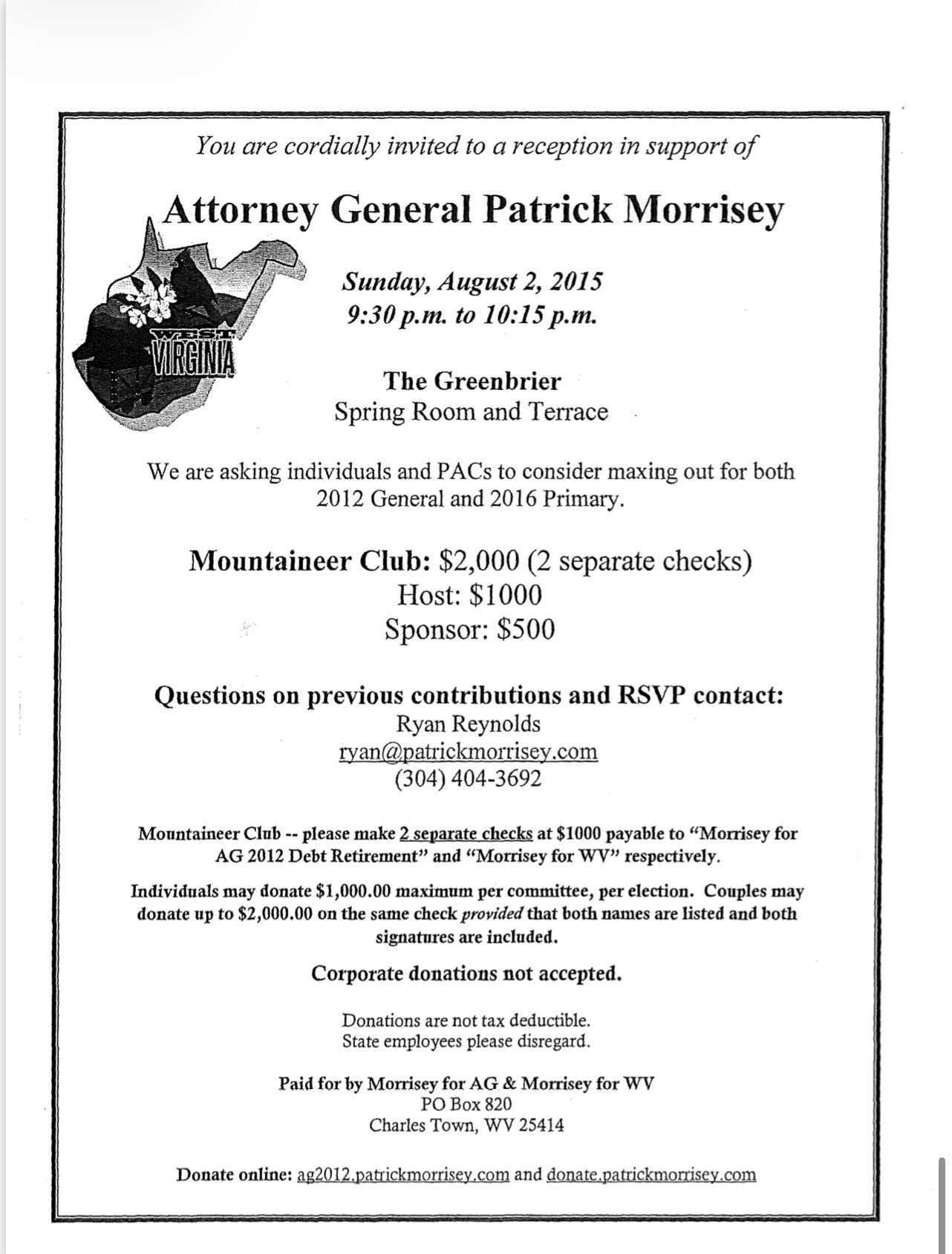
In the August of 2015, Patrick Morrisey — then West Virginia’s Attorney General, today the state’s 37th Governor— stood in a room at the Greenbrier resort and made a frank request of the energy, financial-services, and healthcare executives in front of him: keep writing the checks.
UtilitySecrets.org obtained audio of that fundraiser, hosted by the Republican Attorneys General Association (RAGA). Morrisey was joined by his counterparts from Utah and Montana, Sean Reyes and Tim Fox. In remarks that run only a few minutes apiece, the three Republican AGs explained — in unusually plain language — what donors get in return for their generosity, and how they coordinate with one another and with the national organization that helps re-elect them.
The audio recording would be striking on its own. What gives it weight is that it lands inside a structural story that political scientists have been documenting in the peer-reviewed literature for years. In a 2017 study published through Marquette University, political scientist Paul Nolette argued that state attorneys general have become “a more entrenched part of the national policy landscape,” with “coalitions of mostly Republican AGs aggressively challeng[ing] Obama Administration initiatives such as the Clean Power Plan” and successfully “limited, delayed, or curtailed Obama’s regulatory agenda, particularly during his second term” (Nolette 2017).
The Greenbrier audio is, in effect, the campaign-finance correlate of the legal strategy Nolette describes. This post walks through both.
What Morrisey Told the Room
Speaking to a crowd that, by his own description, included representatives “in the financial services industries, healthcare, energy, across the board,” Morrisey framed his office as a turnaround story for industry:
“I think people used to look at West Virginia and maybe want to run in the opposite direction in terms of the business climate there, but through our office and some of the changes in the legislature, we’ve really been able to … start turn things around.”
He then ticked through his EPA-litigation résumé, anchored on the Clean Power Plan stay his coalition had won at the Supreme Court earlier that year:
“We helped lead the charge against the president’s Power Plan, obtaining the stay. In West Virginia, that’s as good as you can do. When you’re fighting for coal miners and their families … if you can get a stay of the President’s top initiative that matters. If you can get a stay of the Waters of the United States rule, that matters.”
And then came the ask. Not the kind of generic ask that surfaces in stump speeches, but a specific, transactional appeal aimed at the executives in the room:
“The only way I get to stay is through your incredible generosity, so thank you all for coming today. Thanks for your support and if you haven’t written a check, I’d be grateful if you could; if you have already maxed out, if you would consider talking to some of the executives and people that you know, I would be appreciative of it. … I do have a very rich opponent and while we match up very well on the issues, you know it helps to have a little bit more in the way of resources in order to counteract some of those TV buys. So your help really makes a difference.”
He closed by name-checking the rest of the RAGA roster on hand — “General Fox, General Reyes, and obviously you know about the great leadership of Chairman Schuette” — and thanked the room “for coming to the Greenbrier.”
The Pitch from Reyes and Fox: “You Won’t Go Broke”
Tim Fox, Montana’s then-AG, made the coordination explicit. The product on offer was not a single state’s legal docket. It was a 27-, 28-, 29-state coalition acting as one:
“When we collaborate and get together … with Patrick Morrisey and push back against the federal government, or get together and write a letter to the federal government or whatever it is, we make a difference when there is 27, 28, 29, 30 or more attorneys general; people listen, people watch, and it makes a difference. So thank you for supporting each of our attorneys general in RAGA, and thank you for supporting me. You won’t go broke, and it’ll be one of the best investments you’ll ever make.”
Sean Reyes, who later went on to become the subject of the CMD records lawsuit over his RAGA and Rule of Law Defense Fund correspondence, was more colorful — and more direct about who was holding the checks:
“If you have checks for us, I’m taking Missy to the Supreme Court but Alan will be here and Erica can help us out as well. … Just remember that when you are writing those big corporate checks, you’re standing there with me in the ring of a bunch of gangbangers from fifth grade, that’s how I feel with you.”
Three AGs. One coalition. One ask.
The Scholarly Backbone: Why “27, 28, 29” Wasn’t Bluster
Tim Fox’s coalition arithmetic is exactly the dynamic Nolette documents in his Marquette study. He calls it a shift from AGs as “state-focused actors largely disconnected from one another” to a polarized national operation in which “the shape of these partisan coalitions has become quite predictable and stable” (Nolette 2017).
Three findings from the paper directly underwrite the Greenbrier audio recording:
1. RAGA’s reason for being is fundraising and strategy — not litigation in the abstract. Nolette traces RAGA back to its 1999 founding, noting that the organization “focused initially on fundraising goals rather than litigation strategy.” When a Democrat reentered the White House in 2009, Republican AGs “essentially flipped the script” and went on offense; RAGA-coordinated multistate litigation against the Obama administration “entrenched Republican AGs as a strong force against federal regulatory expansion” (Nolette 2017).
2. The Clean Power Plan case was a coordinated, anticipatory partisan effort — and West Virginia led it.Nolette describes the litigation Morrisey was fundraising on as “emblematic of the partisan trends and coalitions among AGs.” Within days of the EPA’s June 2014 CPP rollout, Murray Energy filed in the D.C. Circuit. “A week later, West Virginia AG Patrick Morrissey and eleven other AGs filed an amicus curiae brief supporting Murray Energy’s positon.” The challenge was filed before the regulations were even finalized in the Federal Register, which Nolette flags as “particularly unusual” (Nolette 2017). The coordination wasn’t reactive. It was rehearsed.
3. The donor link to the litigation was a live issue at the time — and the numbers match. Nolette writes flatly: “Democratic AGs demanded that Republican AGs reveal their connections with industry groups during the West Virginia v. EPA litigation, and pointed out that Murray Energy had donated $250,000 to the Republican Attorneys General Association shortly before the litigation began” (Nolette 2017). That figure is the same $250,000 the Center for Media and Democracy independently tallied in its 2015-onward review of fossil-fuel money flowing to RAGA. Two different sources, same number, same timing — and the recipient is the coalition Morrisey was thanking the Greenbrier audience for keeping in business.
Nolette also notes a detail that is easy to miss when you only watch the courtroom: “Republican AGs were already in conversations about how to challenge the CPP before even the proposed rules were announced.” That is the operational meaning of Fox’s line on the audio recording — “you won’t go broke, and it’ll be one of the best investments you’ll ever make.” Donors weren’t underwriting a particular case. They were underwriting an anticipatory, multi-year coalition that was already in motion before the rules existed.
What the Money Was Buying
RAGA’s own 2016 year-in-review reads less like a legal-office annual report and more like a customer success deck for the fossil-fuel and utility sectors. Per the association:
“Republican attorneys general led the fight against President Obama’s overreaching, illegal EPA regulations, resulting in the Supreme Court to halt implementation of Obama’s signature climate change initiative, the Clean Power Plan.”
The same document lists wins on the EPA’s WOTUS rule, the mercury rule (Michigan v. EPA), BLM fracking rules, the prairie-chicken designation, Keystone XL, and the EPA’s “Sue and Settle” practice. Nearly every item maps onto a specific industry priority — and each of those wins is one Nolette documents inside the broader pattern of “kitchen sink” multistate strategy (Nolette 2017).
Documents previously obtained by the Center for Media and Democracy show how that alignment was produced. At an August 2015 RAGA summit in West Virginia — less than two weeks before GOP AGs petitioned federal courts to block the Clean Power Plan — Murray Energy and Southern Company paid for private meetings with the same attorneys general. The agenda included a panel called “The Dangerous Consequences of the Clean Power Plan & Other EPA Rules,” staffed by Mike Duncan of the American Coalition for Clean Coal Electricity, Geoffrey Barnes of Murray Energy, and three AGs: Scott Pruitt, Ken Paxton, and Patrick Morrisey.
The attendee list from that summit, per CMD, included Koch Industries, AFPM, ACCCE, the American Chemistry Council, ANGA, Devon Energy, Edison Electric Institute, Georgia Power, the National Mining Association, NextEra Energy, the Nuclear Energy Institute, Peabody Energy, and the State Policy Network, among others.
CMD’s tally of what those interests were paying RAGA since 2015:
ExxonMobil: at least $100,000
Koch Industries: $350,000
Southern Company: $85,000
American Coalition for Clean Coal Electricity:$378,250
Murray Energy: $250,000
Total from fossil fuel interests, utilities, and their trade groups: more than $2.25 million
Corporations can pay up to $125,000 in RAGA “premium” membership dues for the privilege of private briefings with AGs and their staff — alongside “a five-hour golf game, and a National Rifle Association-sponsored shooting tournament,” as CMD described the recreational programming.
The Utility Pattern: Heavy on the Right, Selective on the Left
The donor pattern is not random. Across governor-level association giving:
American Electric Power, Duke Energy, and NextEra Resources contributed a combined $574,413 to the Republican Governors Association and $0 to the Democratic Governors Association.
Eleven additional utilities donated to RGA and not DGA. So did Dominion CEO Thomas Farrell and AEP CEO Nick Akins, personally.
Southern Company and the Edison Electric Institute gave to both committees — but at significantly different levels.
Only PSEG gave more to DGA than RGA. Only Xcel split evenly. Only Puget Sound Energy gave to DGA alone.
At the AG level in the first six months of 2017, the top utility funders of RAGA — Southern Company, EEI, and NextEra — were each in at $50,000. EEI and NextEra gave the Democratic counterpart, DAGA, half that. Of eight additional utilities donating to RAGA, only Dominion also gave to DAGA.
That asymmetry has a logic. In most states, the governor appoints the public service commissioners who regulate utility rates and capital plans, and the AG litigates the federal rules that determine what those utilities have to spend on emissions controls. As Nolette puts it, AGs operate “largely independently from other state officials” and have used their offices “creative[ly]” to achieve “national public policy goals” — meaning a single elected AG can swing federal regulatory outcomes that no single state legislator or PSC commissioner can (Nolette 2017). Buying influence at both nodes — cheaply, by the standards of utility-scale capex — is a defensible line item for any company whose business model depends on coal, gas, or the pace of the energy transition.
Why This Still Matters in 2026
Three reasons the Greenbrier audio recording is not just a historical artifact.
1. The pitchman now runs the state. Morrisey was sworn in as West Virginia’s 37th governor on January 13, 2025, after defeating Huntington mayor Steve Williams in November 2024 (WV Encyclopedia). The official biography on governor.wv.gov leads with West Virginia v. EPA, the 2022 Supreme Court ruling that grew out of exactly the EPA-litigation track he was fundraising on at the Greenbrier — the same case Nolette identified in 2017 as “emblematic of the partisan trends and coalitions among AGs” (Nolette 2017). The donors who helped keep him in the AG’s office in 2016 now have a direct line to the executive branch — and to the appointees who sit on the West Virginia Public Service Commission.
2. The coordination model is still operating, and still partly hidden. The Center for Media and Democracy sued Utah AG Sean Reyes over his refusal to turn over emails and other records detailing his dealings with RAGA and the Rule of Law Defense Fund — the same 501(c)(4) the CMD documents tied to Clean Power Plan strategy meetings in April 2016. Reyes is the same AG who, on audio recording at the Greenbrier, told corporate donors “if you have checks for us, I’m taking Missy to the Supreme Court.”
3. The governor’s chair is the next prize. A Center for American Progress Action Fund analysis at the time argued that meaningful U.S. climate action would require expanding the map of states actively curbing carbon pollution, naming New Jersey, Florida, Ohio, Wisconsin, Illinois, and Michigan as critical 2018 contests. Several of those governorships have since flipped repeatedly. Indiana Gov. Eric Holcomb signed anti-rooftop-solar legislation; Maine Gov. Paul LePage vetoed pro-solar legislation; both moves were utility priorities. The Greenbrier audio recording is, in effect, a template — and the template scales beyond the AG office.
The Quote That Should Outlive the News Cycle
Strip away the legal posture, the panel agendas, and the donor totals, and what remains is one sentence from a Republican attorney general — now a sitting governor — to a room full of corporate executives:
“The only way I get to stay is through your incredible generosity.”
Nolette’s broader claim, drawn from years of multistate-AG data, is that the Obama-era legal battles “simply cannot be characterized as involving ‘the states versus the national government.’ Instead, these battles involve sharp conflicts among the states themselves, with some challenging and others defending the exercise of federal power” (Nolette 2017).
Translated out of academic language: the side a state ends up on is not a function of its geography, its economy, or even its voters. It is a function of who its attorney general is, which national coalition that AG belongs to, and who is funding the coalition. The Greenbrier audio is what that funding sounds like when it is happening in the room.
The customers, on that day at the Greenbrier in 2015, were the country’s largest utilities, fossil-fuel producers, and their trade associations. The product was the legal and political firepower of state attorneys general, coordinated through RAGA and the Rule of Law Defense Fund.
Ten years later, in West Virginia, the vendor is the governor.
Audio: UtilitySecrets.org. Underlying RAGA documents and corporate-donor totals: Center for Media and Democracy. Scholarly grounding on AG coalition behavior, RAGA’s origin, the West Virginia v. EPA litigation timeline, and the Murray Energy $250,000 RAGA donation: Paul Nolette, “The Dual Role of State Attorneys General in American Federalism: Conflict and Cooperation in an Era of Partisan Polarization,”Marquette University Political Science Faculty Research and Publications, July 2017.


